

How to Shop a Diamond Jewelry Collection with Confidence
How to Shop a Diamond Jewelry Collection with Confidence
A diamond jewelry collection can place rings, earrings, bracelets and necklaces one click apart, but those categories solve different wearing needs. The useful comparison is not simply which piece sparkles most in a photograph. It is whether the design suits the wearer, whether the item description identifies what is being sold and whether documents and policies can be checked before the return window closes.
Diamond2Deal’s current owned website exposes collection routes for diamond eternity rings, stud earrings, tennis bracelets and pendant necklaces, along with a 4Cs education page and return policy. This guide uses those routes for navigation context only. It does not claim current inventory, price, certification, grading, value, origin, treatment, shipping, returns, warranty or product performance.
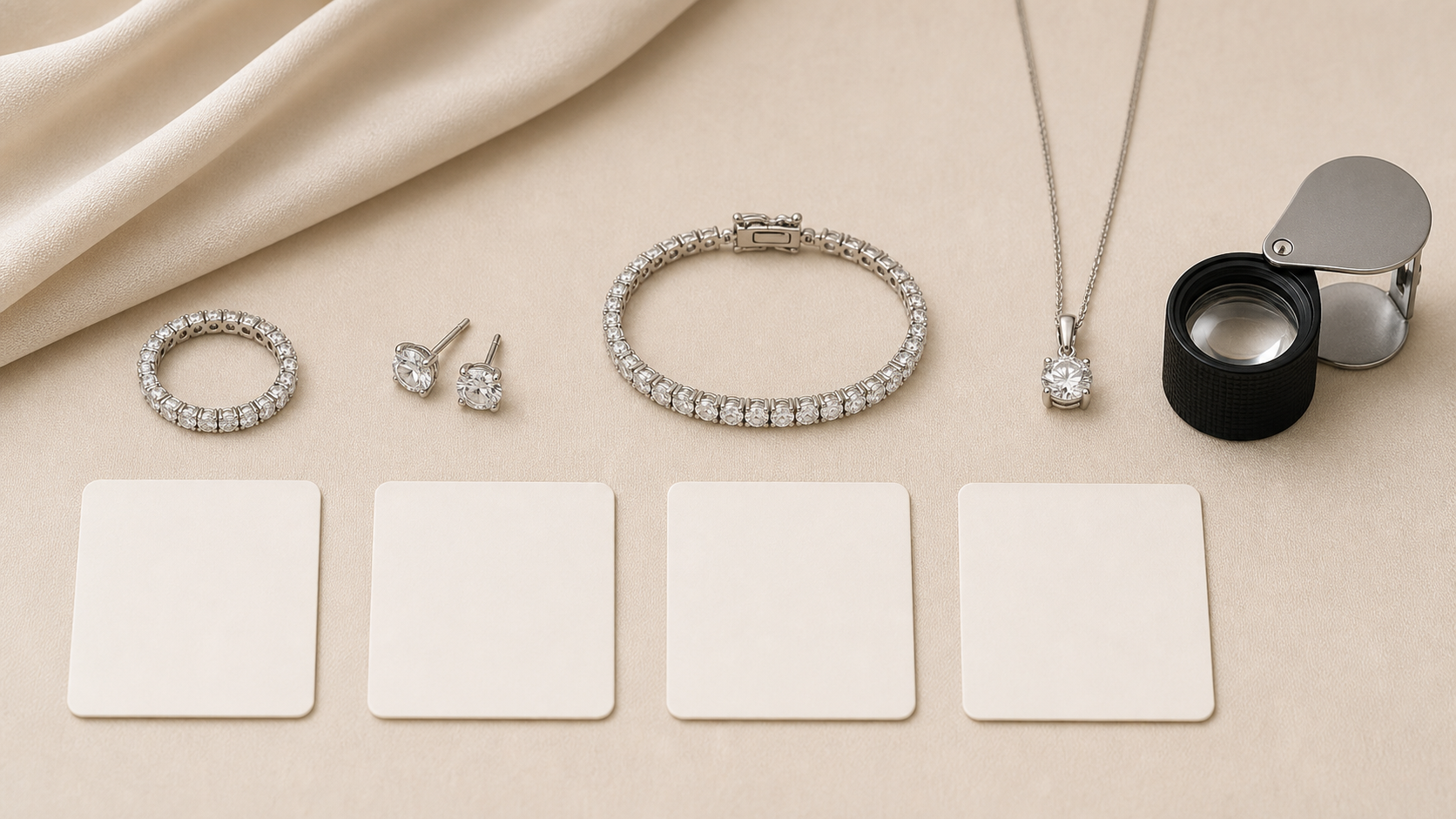
Start with the wearer and jewelry category
Begin with frequency, lifestyle, comfort and care. A piece intended for daily wear faces different snagging, impact and cleaning conditions from jewelry reserved for events. Record sensitivities, preferred metal colour, fit, stacking plans and whether the wearer wants a subtle or high-presence design.
| Category | Decision questions | Details to verify |
|---|---|---|
| Eternity or diamond ring | Will it stack with another ring? Does the design allow future sizing? | Ring size, stone coverage, setting profile, inside finish and resizing policy |
| Stud earrings | What diameter and profile feel balanced? How secure and comfortable are the backs? | Pair matching, setting, post, backing, stated weight basis and measurements |
| Tennis bracelet | Is the length comfortable with safe movement? How do the clasp and safety features operate? | Length, width, links, clasp, metal, setting and total weight terminology |
| Pendant necklace | Is the chain length appropriate for the neckline and daily movement? | Pendant dimensions, chain, clasp, bail opening, metal and removable components |
Diamond2Deal provides current navigation to diamond eternity rings, diamond stud earrings, diamond tennis bracelets and diamond pendant necklaces. Treat each collection as a route for browsing. Open the live product record and verify availability and exact details for the item being considered.
Compare setting, metal, dimensions and fit
A close photograph can make very different pieces look similar. Request measurements and examine the full construction: front, side, back, clasp, gallery, prongs or bezel, joints and chain connections. Ask whether images show the exact item, a representative item, a render or an enlarged detail. Screen size cannot establish physical scale.
- Metal: ask for the stated metal and fineness, colour, finish, plating if any, and whether all components share the same specification.
- Setting: understand how stones are held and how exposed edges fit the intended use.
- Dimensions: compare millimetre measurements, not photography alone.
- Fit: confirm ring size, bracelet length, chain length, earring back and any adjustment or sizing limits.
- Care: ask for cleaning, inspection and repair guidance for that construction.
There is no universal “best” setting or metal. A lower-profile design may suit a person who works with their hands, while another shopper may prioritize visibility. The key is connecting a design choice to daily use and getting the item specification in writing.
Read every stone disclosure precisely
Stone descriptions need exact language. The U.S. Federal Trade Commission’s consumer guidance explains the importance of knowing whether a stone is mined, laboratory-created or simulated and whether treatments affect its appearance. Although Canadian transactions follow applicable Canadian law, the comparison principle remains useful: do not infer stone identity from appearance or a broad collection name.
Ask the seller to identify, for the exact item:
- Whether each represented stone is a diamond or another material.
- Whether diamonds are described as natural or laboratory-grown.
- Whether treatments or enhancements are disclosed.
- The number of stones and whether stated carat weight is per stone, for a pair or total across the piece.
- Which colour, clarity and cut descriptions apply to which stones.
- Whether measurements, tolerances or ranges apply.
- Whether a named laboratory report accompanies a particular stone or item.
For multi-stone jewelry, a total carat weight does not describe the size of every component stone. A broad colour or clarity range is also different from an individual grading result. GIA explains that specialized laboratory testing is used to distinguish laboratory-grown from natural diamonds; visual appearance by itself is not reliable identification.
Understand grading reports and appraisals
GIA recommends learning the 4Cs—colour, clarity, cut and carat weight—and obtaining an independent grading report for a diamond when appropriate. Its buying guidance also recommends verifying report information through the issuing laboratory. Diamond2Deal publishes a 4Cs education page; use it as background, then connect the exact live item to its actual documentation.
| Document | What it may do | What not to assume |
|---|---|---|
| Laboratory grading report | Records characteristics observed for the examined stone under the laboratory’s methods | It is not a sale price, appraisal, warranty or endorsement of the seller |
| Appraisal | Provides an opinion of value for a stated purpose and date | It is not automatically the amount another buyer would pay or proof of grading |
| Seller description or receipt | Records representations, item identifiers and transaction terms | It is not independent laboratory analysis merely because it is detailed |
| Insurance schedule | May record accepted property and coverage terms | It does not establish market value for every purpose or guarantee replacement |
Match any report number, inscriptions where applicable, measurements and item description before purchase and again after receipt. Verify through the issuing organization’s own lookup process, not a screenshot supplied by an unknown party. For finished multi-stone jewelry, ask exactly which stones the document covers.
Check returns, shipping, service and payment terms
GIA’s online buying guidance recommends checking the seller’s reputation, return policy, insured shipping, signature requirements and independent appraisal after receipt when appropriate. FTC consumer guidance likewise recommends researching the seller and return terms. Read the live policy before ordering because eligibility may depend on item type, sizing, customization, condition, documentation and timing.
Diamond2Deal maintains an owned return-policy page. This article does not summarize or promise its current terms. Save the version that applies at checkout and ask how a return is initiated, what must be included, who carries shipping risk, what fees may apply and how refunds are processed. Confirm whether resizing, engraving, custom work or special orders affect eligibility.
For delivery, verify the destination restrictions, carrier method, insurance responsibility, signature procedure, packaging and process for a missing or visibly damaged parcel. Use a payment method with protections appropriate to the transaction and retain the product description, order confirmation, correspondence and unboxing evidence.
Use one comparison sheet for shortlisted pieces
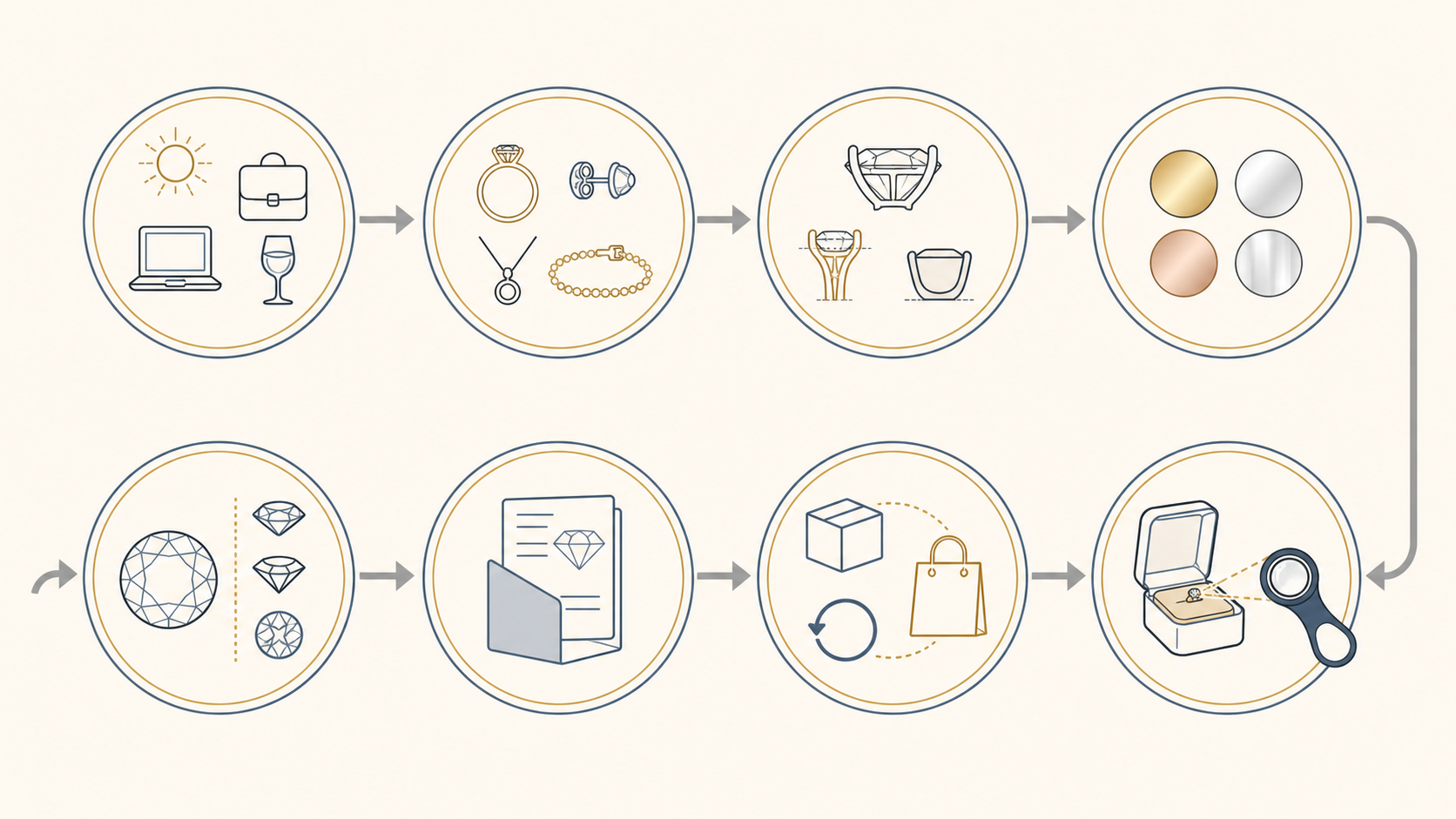
- Save the live URL, item name, SKU or seller identifier and date reviewed.
- Record category, intended use, fit and exact dimensions.
- Copy the metal, setting and component description without paraphrasing.
- Record stone identity, quantity, weight basis, measurements and treatments as stated.
- List every included report by issuer and number, then verify it independently.
- Save the total payable amount and all taxes, duties, sizing, shipping or service charges shown at checkout.
- Attach the return, shipping, repair and warranty terms that apply to that item.
- Write unanswered questions and keep the seller’s written responses.
- Plan receipt inspection within the applicable return period.
This sheet prevents a strong photograph or headline from replacing the actual comparison. Blank fields are not necessarily problems, but they are questions to resolve before purchase.
Common diamond jewelry buying mistakes
- Choosing by image scale: photos may be enlarged, cropped or rendered.
- Treating total carat weight as one stone: confirm whether it covers a pair or all stones.
- Assuming every diamond is natural: require direct identity language.
- Using “certified” as the entire explanation: identify the issuer, document and stone it covers.
- Confusing grading with value: a report and an appraisal answer different questions.
- Ignoring treatments: ask what is disclosed and how it affects care.
- Skipping fit details: dimensions, sizing and clasp design influence daily use.
- Reading policy after purchase: eligibility can be item-specific and time-limited.
- Losing the product record: save the representation that informed the purchase.
Questions to ask the seller before paying
- Is the photograph the exact item, a representative item or a render?
- What are the item’s physical dimensions, fit and complete metal specifications?
- How many stones are present, and what does the stated carat weight include?
- How is each stone represented—as natural diamond, laboratory-grown diamond, simulated stone or another material?
- Are treatments or enhancements disclosed?
- Which grading report, if any, accompanies which stone, and how can it be verified?
- What is included in the shipment, and what must be returned with the item?
- Do sizing, customization or special-order status change the return terms?
- What happens if the delivered item differs from the saved description?
- Which care, inspection, repair or service terms are written for this exact purchase?
Frequently asked questions
Is a grading report the same as an appraisal?
No. A grading report records observed stone characteristics under a laboratory’s methods. An appraisal is an opinion of value for a stated purpose and date. Neither should be treated as the other.
Does total carat weight mean one diamond?
Not necessarily. In earrings or multi-stone jewelry, it may describe all stones in the pair or piece. Ask for the exact weight basis and stone count.
Can you identify a laboratory-grown diamond by looking at it?
GIA says laboratory-grown and natural diamonds are distinguished using specialized laboratory testing. Do not rely on unaided appearance; review item disclosures and appropriate documentation.
Should I arrange an independent inspection after delivery?
It can be useful for a significant purchase. Decide before ordering, understand what the professional will examine and complete it while any applicable return period remains open.
Make the item record stronger than the sales impression
A confident decision comes from matching the jewelry to its wearer and matching every important claim to the exact item. Category, construction, stone disclosure, documents and seller terms should agree. If they do not, pause and get a written answer.
Sources reviewed
- Diamond2Deal website, 4Cs page and return policy — first-party navigation, education and policy context only.
- GIA guide to buying a diamond — 4Cs, independent grading reports and verification.
- GIA online diamond buying guide — seller, report, return, shipping and post-delivery checks.
- FTC gemstone and diamond consumer guide — seller, return, stone-identity and treatment questions.
- GIA laboratory-grown diamond identification — specialized laboratory testing context.