

Three-Stone Rings: Know What Each Stone Means in 2026
Three-stone diamond ring meaning refers to the “past, present, future” symbolism expressed by a center diamond flanked by two side stones. At Diamond2Deal in New York (420 Madison Ave, 5th Floor, Rm 500), we help you choose proportions, shapes, and lab-grown options so your trilogy ring tells your story with clarity and sparkle.
By Mit Trivedi · Last updated: 2026-04-28
Above-Fold Overview
A three-stone diamond ring features one center stone and two side stones that symbolize your past, present, and future. This guide explains the meaning behind the design, how the setting works, the best shapes and ratios, and how to choose a lab-grown trilogy ring with confidence.
Choosing a three-stone engagement ring can feel personal and technical at once. This complete guide balances both—clear definitions, practical steps, and design examples—so you can select a ring that feels meaningful the moment it’s on your hand.
- Understand the story and symbolism behind three-stone rings
- Compare side-stone shapes, metal colors, and center-to-side ratios
- See how settings, prongs, and height affect comfort and durability
- Explore certified lab-grown diamond options for extra value
- Use checklists and tables to make fast, confident decisions
At a Glance
- Meaning: Past, present, future; often tied to a milestone or promise
- Most popular shapes: Round center with round or tapered baguette sides
- Go-to ratio: Many shoppers love ~1 : 0.33 : 0.33 (center : each side)
- Comfort note: Lower-set baskets snag less; 4–6 prongs balance security
- Band pairing: Consider a straight, low-profile wedding band for a flush fit
Table of Contents
- What Is a Three-Stone Diamond Ring?
- Why the Meaning Matters
- How a Three-Stone Setting Works
- Types and Approaches
- Best Practices
- Tools and Resources
- Case Studies and Examples
- Frequently Asked Questions
- Conclusion
What Is a Three-Stone Diamond Ring?
A three-stone diamond ring sets a center diamond between two side stones. The trio represents your relationship’s timeline—past, present, and future. By adjusting shapes, sizes, and setting height, you can tune the look from classic and low-profile to bold and modern while preserving its signature symbolism.
In jewelry terms, you’ll hear “three-stone,” “trilogy,” or “trinity” used interchangeably. The center diamond is typically the largest, with matched side stones that frame and brighten it. A round brilliant at ~6.5 mm (about 1.0 ct) often pairs with side stones around ~4.3 mm (about 0.33 ct each) for a balanced silhouette.
Symbolism: the story you wear
- Past: Your journey to this moment—friendship, growth, and shared memories.
- Present: Your promise today—commitment, support, and joy.
- Future: Your vision together—goals, family, and a lifetime of milestones.
Some couples map specific dates or milestones to each stone. Others attribute virtues (love, fidelity, trust), or choose birthstones as sides to personalize the story.
Anatomy: components that shape the look
- Center stone: Usually largest by carat or spread (face-up size).
- Side stones: Matched pair in carat, shape, and color for symmetry.
- Basket/head: The metal framework that holds each stone; height influences comfort.
- Prongs or bezel: Prongs (4–6) maximize light; bezels add sleek protection.
- Shank/band: Width typically 1.6–2.2 mm for everyday wear comfort.
Popular center-to-side ratios
- 1 : 0.25 : 0.25 Subtle sparkle; slimmer profile and lighter feel.
- 1 : 0.33 : 0.33 Classic balance; side stones clearly frame the center.
- 1 : 0.40 : 0.40 Bolder, near-three-equal look without losing the center focus.
Ratio affects finger coverage, ring weight, and wedding band pairing. Many prefer lower baskets and a straight wedding band for a gap-free stack.
Why the Three-Stone Ring Meaning Matters
Meaning drives confidence, longevity, and everyday joy. When a three-stone ring encodes your story—especially for couples in Manhattan and greater New York County—it becomes more than a style. It’s a wearable commitment that guides shape, metal, and lab-grown choices you’ll be happy with for years.
The symbolism simplifies thousands of options into a personal design brief. Instead of “Which diamonds are best?” you’re asking “Which combination best honors our journey?” That shift keeps decisions focused and satisfying.
- Anchors your choices: If “present” means stability, you may prefer a secure bezel or six-prong center.
- Aligns with milestones: Side stones can represent a graduation, new home, or a first trip together.
- Supports ethical priorities: Lab-grown diamonds let you match color/clarity precisely while supporting your sustainability goals.
We regularly meet shoppers who want symbolism without stress. At our Midtown location, we translate your notes—like “clean, bright, low-snag”—into concrete specs: center spread, side-shape, prong count, and band profile.
For historical context on period cuts you might love in a trilogy, see how heritage shapes evolved in this overview from Old Mine Cut diamonds. Vintage inspiration often pairs beautifully with modern lab-grown brilliance.
How a Three-Stone Setting Works
Three baskets are aligned on a shared band so light flows through all stones. The center sits slightly higher for focus, while side stones taper the silhouette and protect edges. Proper seat cutting, prong tension, and height ensure security, comfort, and a flush fit with a wedding band.
Understanding the mechanics helps you judge quality at a glance. Look for smooth gallery lines, snug prong seats, and stone alignment that traces a gentle arc across the finger.
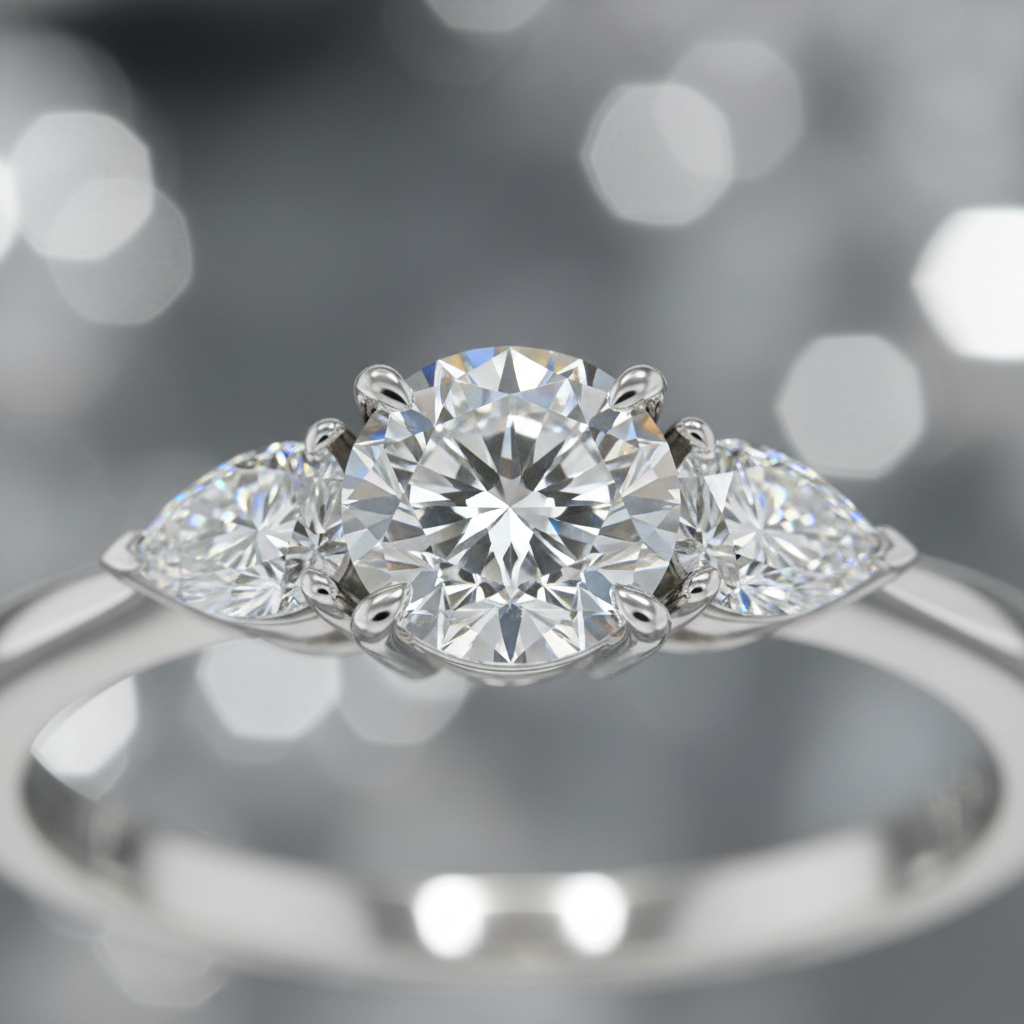
Build sequence (what a jeweler does)
- Design intent: Choose shapes, target ratios (e.g., 1 : 0.33 : 0.33), and ring size.
- CAD or hand-build: Create baskets with proper angles for your stone shapes.
- Seat cutting: Carve precise grooves so each diamond nestles securely.
- Stone setting: Tighten prongs evenly; verify table alignment across three stones.
- Polish and QC: Smooth prongs, check symmetry, and confirm the wedding band fits flush.
Comfort and durability checkpoints
- Height: Lower centers snag less on knits and hair; medium height maximizes sparkle.
- Prongs: 4–6 on the center; 3–4 on side pears/tapers; avoid thin, pointy prong tips.
- Band width: 1.8–2.2 mm supports daily wear without bulk.
- Seat integrity: Stones shouldn’t rotate when gently pressed; no audible rattle.
| Step | What to Check | Why It Matters |
|---|---|---|
| Seat cutting | Even depth, clean bearing marks | Prevents chips and keeps stones stable |
| Prong tension | Firm pressure, matched tip size | Stops rotation and snags |
| Center height | Slightly higher than sides | Creates focus and smooth finger arc |
| Band pairing | Straight band sits flush | Comfortable stack with fewer gaps |
Want to see these choices in action? Compare proportions and setting styles in our practical engagement ring guide and then explore in-stock three-stone examples for side-by-side viewing.
Types/Methods/Approaches
Three-stone rings vary by shape combinations, setting methods, and metal color. Common builds pair a round or oval center with round, pear, or tapered baguette sides. Prong, bezel, or half-bezel settings change the profile, while white, yellow, or rose gold (or platinum) tune the overall character.
Popular shape combinations
- Round + Round + Round: Maximum fire; timeless and easy to stack.
- Round + Pear + Pear: Soft taper that elongates the finger.
- Round + Tapered Baguettes: Sleek, Art Deco vibe with crisp lines.
- Oval + Ovals: Extra spread for the center; graceful, airy look.
- Emerald + Trapezoids: Hall-of-mirrors elegance; modern architecture feel.
Settings: prong vs. bezel
- Classic prongs: 4–6 on the center maximize light and keep a delicate look.
- Half-bezel sides: Protect corners on pears or tapers while staying sleek.
- Full bezel: Ultra-secure and smooth; great for active lifestyles.
Metals and color strategy
- 14k white gold: Bright, durable, and widely loved with lab-grown brilliants.
- 14k yellow gold: Warmer contrast; rounds can pop against the glow.
- 14k rose gold: Romantic hue that flatters many skin tones.
| Side Shape | Visual Effect | Common Meaning | Design Note |
|---|---|---|---|
| Pear | Elongates, soft taper | Grace, direction | Protect tips; 3–4 prongs |
| Tapered Baguette | Sleek, architectural | Stability, focus | Lower height for flush bands |
| Round | Maximum sparkle | Wholeness, unity | Easy to match in pairs |
| Trapezoid | Frames step-cuts | Balance, symmetry | Ideal with emerald centers |
Exploring period shapes? This brief on stone recutting and transformation highlights how old cuts inform modern designs—useful if you want a vintage nod in a lab-grown trilogy.
Best Practices
Decide on meaning first, then translate it into specifications you can verify. Lock your center shape and desired ratio, confirm color/clarity with lab certification, and check setting height and prong security. Finally, test the wedding-band fit so your everyday stack sits flush and comfortable.
Turn symbolism into specs
- Pick your story: Past–Present–Future, virtues, or milestones.
- Choose a center shape: Round for fire; oval for finger length; emerald for sleek lines.
- Set a ratio target: 1 : 0.25–0.40 per side, then preview with layouts.
- Confirm certification: Request reputable lab grading for color, clarity, and cut.
Comfort-first checks
- Height & snag factor: Lower galleries and rounded prong tips for knit-friendly wear.
- Band width: 1.8–2.2 mm keeps daily wear balanced.
- Flush stack: Mock the wedding band alongside the engagement ring before finalizing.
Lab-grown advantages
- Precision matching: Easier to source identical side stones for perfect symmetry.
- Education-first: Our resources explain cut, color, and clarity so you can compare confidently.
- Speed: Thousands of in-stock styles ship fast when you’re on a tight timeline.
Use our wedding ring guide to plan your stack. Then browse in-stock three-stone designs like this 1 ct three-stone ring or this balanced 0.99 ct trilogy to visualize proportions on your hand.
Tools/Resources
Use measurement tools, side-by-side photos, and certification reports to make objective choices. A ring sizer, calipers, and ratio mockups help you confirm comfort and look. Pair that with an education guide and in-stock examples to see how numbers translate to real sparkle.

- Education hub: Learn how cut, color, clarity, and carat interact in our lab-grown engagement ring guide.
- Engagement ring guide: Compare settings, prongs, and profiles in our engagement ring guide.
- In-stock references: Try on proportions digitally with the 1.13 ct round three-stone.
Looking for romantic framing for your proposal story? See these notes on jewelry meaning and proposals to spark ideas while you design your ring’s message.
Case Studies/Examples
Real choices bring the meaning to life. Here are quick snapshots from Diamond2Deal appointments—each couple defined a story, then we translated it into shapes, ratios, and settings that fit their lifestyle and stack with a wedding band comfortably.
Example 1: “Two coasts, one home”
A Manhattan couple split time between New York and California. They chose a round center (~6.5 mm) with tapered baguette sides at ~0.33 each in 14k white gold. The taper symbolizes a shared path converging on the center—“present.” A straight 2.0 mm band stacks flush for travel-ready wear.
Example 2: “Milestones that built us”
For two professionals who marked grad school, first jobs, and a new apartment, we used oval center (~8 x 6 mm) with pear sides at ~0.30 each in yellow gold. The pears point toward the center to highlight today’s commitment, while the warm metal honors a vintage family ring.
Example 3: “Active lifestyle, minimal snag”
A nurse wanted a smooth profile for glove-friendly wear. We set a round center in a 6-prong medium-low basket with round sides, all with softened prong tips and a 1.9 mm band. The ring clears daily tasks while keeping the trilogy symbolism intact.
Local considerations for Manhattan
- Try-on timing: Book mid-day appointments to avoid rush-hour crowds near Grand Central and keep enough time for diamond comparisons.
- Seasonal wear: Winter knits can snag; consider lower baskets and bezel sides if you commute by subway during colder months.
- Proposal planning: If you’re capturing photos around Rockefeller Center, polished prongs and a clean band help the ring read crisply in close-ups.
Need a second opinion? Our family team has guided customers since 1998. Share your story and we’ll translate it into a center shape, side-stone pair, and setting height that feel just right—then ship fast when you’re ready.
Frequently Asked Questions
Three-stone rings raise practical questions about meaning, ratios, and daily wear. These quick answers cover the essentials—symbolism, popular proportions, wedding-band pairing, and lab-grown options—so you can move from research to a confident shortlist in minutes.
What does each stone represent in a three-stone engagement ring?
The three stones traditionally represent your past, present, and future together. Many couples personalize this further—assigning milestones, virtues, or even family birthstones to each position to tell a more specific story.
What is a good center-to-side ratio for balance?
A common sweet spot is about 1 : 0.33 : 0.33 (center : each side). For a ~6.5 mm round center, side stones around ~4.3 mm each create a classic, balanced frame without overpowering the center.
Do three-stone rings pair well with wedding bands?
Yes. Choose a setting with a slightly elevated center and lower side baskets, then test a straight wedding band alongside it. A 1.8–2.2 mm band typically stacks flush and feels comfortable for daily wear.
Are lab-grown diamonds a good choice for three-stone designs?
They’re excellent. Lab-grown diamonds make it easier to match side stones closely for symmetry, and certification helps you verify color, clarity, and cut. Many shoppers appreciate the ability to compare options quickly and ship fast.
Conclusion
Meaning first, specs second. Define your trilogy story, choose shapes and ratios that express it, confirm comfort and security, then preview the wedding-stack fit. With clear steps—and fast access to certified lab-grown options—you’ll land a three-stone ring that feels personal from day one.
Key Takeaways
- Three stones = your past, present, and future in a single, elegant design.
- Start with a target ratio (e.g., 1 : 0.33 : 0.33) to frame your center.
- Lower baskets and softened prongs boost comfort for city life.
- Lab-grown options simplify matching, education, and speed.
Next Steps
- Skim our engagement ring guide and shortlist shapes you love.
- Preview proportions with in-stock designs like this 3/4 ct trilogy.
- Plan your stack with the wedding ring guide so the fit is flawless.
- Ready to move? Our family team will help finalize specs and ship quickly from New York.