

Women’s Wedding Band Style Guide: Find Your Perfect Match (2026)
Women’s wedding band styles are the design families, metal choices, and setting techniques that shape how a band looks, wears, and pairs with your engagement ring. At Diamond2Deal’s New York showroom office at 420 Madison Ave in Manhattan, we help you compare profiles, widths, and setting types so you can choose a band you’ll love for decades.
By Mit — President, Diamond2Deal • Last updated: May 1, 2026
At a Glance
Women’s wedding bands fall into clear categories: plain gold, pavé and micro‑pavé, channel‑set, bezel and bar‑set, half or full eternity, curved/contour, and guard wraps. Key decisions include metal color (white, yellow, rose), karat (14k vs 18k), width, profile, and comfort fit. Pairing and long‑term care complete the plan.
- What you’ll learn: How to choose width, profile, metal, and setting — and match a band to your lifestyle.
- Why it matters: The right band protects your engagement ring, stacks cleanly, and stays comfortable all day.
- Use this guide to: Compare styles, build a stack, and prep questions for a Diamond2Deal appointment.
Quick navigation
- What is a women’s wedding band?
- Why band style matters
- How to choose in 5 steps
- Women’s wedding band styles (core categories)
- Metals, karats, and finishes
- Fit, profile, and daily comfort
- Pairing with your engagement ring
- Care, durability, and maintenance
- Trends for 2026
- Tools & resources
- Case examples
- FAQ
- Key takeaways
What is a women’s wedding band?
A women’s wedding band is a circular ring worn after marriage that complements or stacks with an engagement ring. It’s defined by metal (gold or platinum alternatives), width, profile, and stone‑setting style. The goal is lasting comfort, beauty, and secure settings that fit daily wear without damaging the engagement ring.
A band seems simple — a circle of metal — but small choices transform how it feels and looks. Width and profile shape the silhouette. Setting style affects sparkle and snag resistance. Metal color ties everything together.
- Core components: metal, width, profile, finish, and (if applicable) diamonds or gemstones.
- Fit factors: comfort-fit interior, true-to-size vs. half-size, and how the band nests with your engagement ring’s gallery.
- Everyday realities: snag risk, glove use at work, frequent handwashing, gym routines, and travel all influence the right style.
At Diamond2Deal, most clients begin with our plain gold and lab-grown diamond band lineup. Then we refine by lifestyle and pairing needs using our education-forward process and next-day shipping on thousands of in-stock styles.
Why band style matters
Your wedding band does more than mark the moment — it affects comfort, ring security, and long-term maintenance. Choosing the right width, profile, and setting reduces snagging, protects prongs on the engagement ring, and ensures a balanced stack you’ll enjoy wearing every day.
- Daily comfort: A rounded inner wall (comfort fit) reduces pressure points during long days.
- Ring safety: Low-profile settings lessen snagging on sweaters or hair and help protect delicate engagement-ring prongs.
- Visual balance: Matching widths (e.g., a 2.0–2.5 mm band with a similar shank) creates a unified look.
- Future flexibility: Straight bands stack more easily if you plan to add an anniversary ring later.
We’ve seen that couples who consider “how I live” — desk work, healthcare, fitness, hands-on creativity — feel more confident. The right wedding band becomes a daily companion, not a delicate accessory you’re afraid to wear.
How to choose your band in 5 steps
Start with your engagement ring’s silhouette, then pick a width, profile, and metal that complement it. Choose a setting style that matches your lifestyle, confirm comfort-fit sizing, and test stack alignment. When in doubt, book a short appointment to try options side by side before committing.
- Map your engagement ring: Note shank width, height, and prong or bezel style.
- Pick a width range: Popular everyday widths span roughly 1.5–3.0 mm; sculptural looks go 4–6 mm.
- Choose metal and karat: Decide white, yellow, or rose tone in 14k or 18k gold.
- Select a setting type: Plain, pavé/micro‑pavé, channel, bezel, bar‑set, half or full eternity.
- Check comfort and stack: Try on with your engagement ring; confirm it sits flush or intentionally offset.
Prefer guided shopping? Our team at 420 Madison Ave in Manhattan can model stacks, review profiles under magnification, and ship your final choice with next‑day fulfillment on many in‑stock bands.
Women’s wedding band styles (the core categories)
The main wedding band families include plain gold, pavé and micro‑pavé, channel‑set, bezel or bar‑set, half‑eternity, full‑eternity, curved/contour, and guard wraps. Each offers a distinct balance of sparkle, snag resistance, and maintenance, letting you match form and function to your lifestyle.
Plain gold bands
- Why choose: Timeless, low maintenance, and stack-friendly. Great for active wearers.
- Looks best when: You want a clean silhouette that won’t compete with a bold center stone.
- Explore options: Classic half‑round profiles in 3.0 mm or a slimmer 2.5 mm.
Pavé and micro‑pavé bands
- Why choose: Continuous sparkle with tiny prongs securing each diamond.
- Best for: Dressy looks that still sit low; pairs beautifully with solitaire engagement rings.
- Tip: Micro‑pavé uses smaller stones and finer prongs for a delicate “diamond dust” effect.
Channel‑set bands
- Why choose: Stones are protected by metal walls — smooth and snag resistant.
- Best for: Hands-on jobs where gloves or fabrics could catch on prongs.
- Pairing idea: Combine a channel band with a pavé engagement ring for contrast.
Bezel and bar‑set bands
- Why choose: Metal surrounds or grips stones between bars for excellent security.
- Great when: You want modern, graphic lines with maximum everyday durability.
- Note: Slightly more metal-forward look; gorgeous in white or yellow gold.
Half vs. full eternity
- Half‑eternity: Diamonds cover the top half — easier to size later; comfortable for typing.
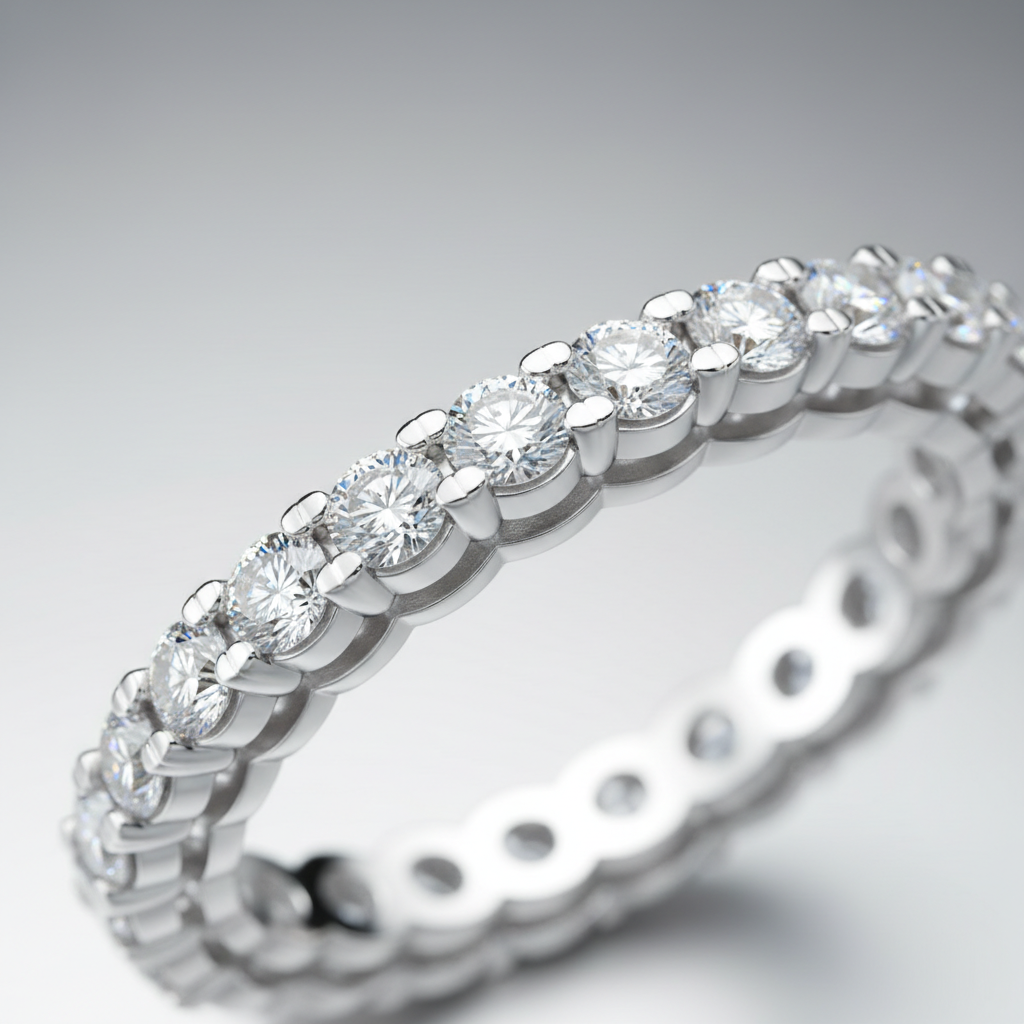
- Full‑eternity: Stones go all the way around for 360° sparkle. Precise sizing matters.
- See a sample: Our lab‑grown full‑eternity band shows seamless micro‑pavé brilliance.
Curved/contour bands and guard wraps
- Curved/contour: Gentle arc follows an engagement ring’s head to sit flush.
- Guard wraps: A protective wrap or double-band enhances presence and prevents spinning.
- When to choose: If your engagement setting sits low or has a wide basket that needs clearance.
Metals, karats, and finishes
Most women’s bands are crafted in 14k or 18k gold: white for cool brilliance, yellow for warmth, and rose for a blush tone. Finishes range from high polish to satin, brushed, hammered, and matte. Choose a karat and finish that match your skin tone, style, and maintenance preferences.
- 14k vs 18k: 14k is commonly chosen for everyday durability; 18k offers richer color with a bit more softness.
- Color matching: Match metal to your engagement ring for unity, or mix metals for a modern stack.
- Finish options: High polish shines; satin/brushed mutes reflections; hammered adds artisanal texture.
- Gold basics: “Karat” indicates gold purity (out of 24 parts). Learn fundamentals from an accessible gold purity overview.
In our experience, clients who want minimal upkeep lean toward 14k white or yellow gold with a polished finish. Texture lovers often pick brushed or hammered to hide micro-scratches from everyday wear.
Fit, profile, and daily comfort
Comfort fit bands feature a rounded interior that reduces pressure on the finger, especially for widths above ~2.5 mm. Profile — half‑round, flat, or low‑dome — changes the look in profile and how the edges feel against adjacent fingers during work and workouts.
- Widths: Slim bands often range around 1.5–2.0 mm; classics center near 2.0–3.0 mm; bold looks go 4.0 mm or wider.
- Profiles: Half‑round is timeless; flat offers a sleek, modern line; low‑dome softens the flat look.
- Comfort fit: Noticeably easier to slide over knuckles; helpful for those with varying finger swelling.
- Try these: Compare a 5 mm classic with a 3 mm edged to feel the difference.
Hands change over time with seasons, hydration, and activity. That’s why we confirm fit at multiple points in the day before finalizing a size, especially for eternity bands that can’t be resized easily.
Pairing with your engagement ring
For a balanced stack, match relative widths, align profiles, and choose a complementary setting style. A curved band can sit flush with low heads, while straight bands keep future-stacking options open. Test alignment face-up and from the side to ensure the engagement ring’s prongs are protected.
- Solitaire pairing: Micro‑pavé or channel‑set bands add sparkle without overpowering a single stone.
- Halo pairing: Slim, plain gold keeps focus on the halo’s footprint.
- Three‑stone pairing: Consider a curved or contour band to clear wider galleries and sit flush.
- Guard wrap use: Adds presence and stability for tall settings that tend to spin.
We routinely demo stacks for New York clients by placing bands under magnification, then photographing side profiles. Seeing prong clearance and gallery alignment removes guesswork before you choose your forever set.
Care, durability, and maintenance
Choose sturdy settings for daily wear, clean with a soft brush and mild solution, and schedule periodic inspections. Plain and channel‑set bands minimize snagging; pavé and micro‑pavé bring sparkle but need occasional professional checks to ensure stones and prongs stay secure.
- Everyday care: Rinse after workouts and lotions; dry thoroughly to reduce residue film.
- Home cleaning: A small bowl, warm water, and mild soap paired with a soft brush keep brilliance lively.
- Periodic checks: Inspect prongs and channels under bright light; book professional inspections at sensible intervals.
- Long-term tip: If you’re hard on jewelry, favor channel, bezel, or bar‑set over micro‑pavé.
Diamond is exceptionally hard on the Mohs scale, and gold is a precious metal designed for longevity. Still, settings deserve attention. A quick annual inspection aligns with how we maintain other daily essentials — small routines that prevent larger repairs.
Women’s wedding band trends for 2026
In 2026, sleek stacks, mixed metal pairings, and micro‑pavé half‑eternity bands lead the way. Lab‑grown diamond bands expand selection for exacting color and clarity preferences, while textured finishes and airy guard wraps offer fresh, modern silhouettes without sacrificing comfort.
- Minimalist stacks: Two slim bands (1.5–2.0 mm) framing a solitaire are in high demand.
- Mixed metals: White gold with a warm rose accent gives dimension without bulk.
- Texture play: Brushed centers with polished edges read quietly luxe.
- Lab‑grown selection: Consistent color and clarity simplify matching across multiple bands.
Not sure what’s timeless vs. trending? We help you weigh short‑term fashion against long‑term joy so your band feels current today and classic tomorrow.
Tools and resources
Use guided learning, expert appointments, and quick shipping to simplify your decision. Start with education pages, then try a short consult to compare widths and settings live. Many Diamond2Deal bands ship next day, so you can finalize a stack without weeks of delay.
- Read our concise wedding ring guide to ground terminology.
- Skim the engagement ring guide to understand pairing geometry.
- Browse an in‑stock 5 mm half‑round with edge next to a sleek 3 mm classic to visualize scale.
- Want a full‑sparkle look? Review this micro‑pavé eternity for reference.
- For seasonal inspires, glance at a friendly holiday jewelry overview.
Case examples (how we match styles to real lives)
We fit bands to daily routines. Desk‑first days can support slim micro‑pavé, while hands‑on work often prefers channel or bezel security. Below are brief scenarios showing how we recommend widths, settings, and stacks that protect prongs, reduce snags, and keep comfort high.
Healthcare professional, always on the move
- Profile need: Low‑set stones to avoid glove snags.
- Style pick: 2.0–2.5 mm channel‑set or bezel‑set half‑eternity to balance sparkle and smooth edges.
- Result: Confident daily wear with minimal catching on fabric.
Creative pro typing all day
- Profile need: Comfortable edges that won’t press during long keyboard sessions.
- Style pick: 2.0 mm comfort‑fit half‑round or micro‑pavé half‑eternity with polished edges.
- Result: Subtle sparkle and all‑day comfort at the desk.
Weekend athlete and traveler
- Profile need: Durability with simple care on the go.
- Style pick: Plain 2.5–3.0 mm half‑round or bar‑set band; add a guard wrap for stability.
- Result: A worry‑less ring you don’t need to baby between workouts and flights.
Setting styles vs. practical benefits
Compare setting types by snag resistance, ease of cleaning, and resizing flexibility. Pavé maximizes sparkle with tiny prongs; channel and bezel secure stones in protective metal; full eternity dazzles 360° but requires precise sizing. Use this at‑a‑glance grid to narrow your shortlist fast.
| Setting | Snag resistance | Cleaning | Resizing | Best for |
|---|---|---|---|---|
| Pavé / micro‑pavé | Moderate (tiny prongs) | Easy with soft brush | Half‑eternity: yes; Full‑eternity: no | Everyday sparkle, slim stacks |
| Channel‑set | High (stones recessed) | Very easy | Often yes | Active hands, glove use |
| Bezel / bar‑set | High (metal surrounds/holds) | Easy | Often yes | Maximum security, modern look |
| Plain gold | Very high | Very easy | Yes | Low maintenance, timeless |
| Full‑eternity | Moderate (prongs present) | Easy, careful around prongs | No | 360° sparkle showpiece |
How style choice plays out in Manhattan (New York County)
In Manhattan’s fast pace, low‑snag settings and comfort‑fit interiors shine. Commuters and hands‑on roles benefit from channel, bezel, or slim plain bands, while nightlife stacks lean micro‑pavé. We help New York County clients test stacks against real routines before we ship in‑stock picks next day.
Local considerations for Manhattan
- Try‑on timing: Swing by after work near Rockefeller Center to test fit when hands are slightly warm from the day.
- Seasonality: Winter gloves favor lower‑profile bands; in summer, slight swelling makes comfort‑fit sizing feel better.
- Transit reality: If you commute via Grand Central, choose snag‑resistant settings that won’t catch on bags or coats.
Education cues and shopping confidence
Clarity comes from knowing the terms and seeing real comparisons. Use plain‑language guides, quick expert chats, and side‑profile photos to confirm prong clearance, width balance, and setting security. With that, your final pick feels unmistakably right — not a guess.
- Start with definitions and photos in our wedding ring guide.
- Review proposal‑focused tips from a proposal ring guide to re‑center on meaning.
- When you’re ready, compare side profiles using a 2.5 mm plain band versus a micro‑pavé half‑eternity to check prong clearance.
Frequently Asked Questions
Most questions focus on pairing, sizing, and maintenance. Choose a width that echoes your engagement ring’s shank, test flush fit or a curved band, favor comfort‑fit interiors for daily wear, and plan simple cleaning plus periodic professional inspections to keep sparkle and security high.
What width should I choose for everyday comfort?
Many daily-wear stacks feel balanced around 2.0–2.5 mm, but the best width echoes your engagement ring’s shank and your finger size. Try a slim and a classic width back to back. Comfort‑fit interiors help larger widths slide over knuckles and feel great all day.
Should my wedding band sit flush with my engagement ring?
Flush is lovely, but not required. If your setting’s head sits low or wide, a curved or contour band creates a seamless fit. Straight bands keep future stacking flexible. Check face‑up and side views to make sure prongs stay protected and the stack looks intentional.
Half‑eternity or full‑eternity — which is better for me?
Half‑eternity bands place diamonds across the top and allow resizing later. Full‑eternity offers 360° sparkle but needs precise sizing and professional care. If you type all day or want future flexibility, half‑eternity is often the more practical choice.
What metal should I choose — white, yellow, or rose gold?
Match your engagement ring’s metal for a unified look, or mix metals for dimension. 14k gold balances durability and luster for daily wear. 18k offers richer color with a touch more softness. Try both to see which tone flatters your skin and style.
Key takeaways
Decide on width, profile, metal, and setting based on how you live, then confirm stack alignment with your engagement ring. When you match form and function, your band looks beautiful, wears comfortably, and stays secure for the long run.
- Start with your engagement ring’s proportions.
- Pick a metal and finish you’ll enjoy maintaining.
- Choose a setting that matches your daily routine.
- Confirm comfort fit and side‑profile protection for prongs.
Conclusion and next steps
The best wedding band blends beauty and practicality. Align width, profile, and setting with your routine, then view the stack from every angle to protect prongs and ensure comfort. Use education pages, quick consults, and in‑stock shipping to make a confident, timely decision.
- Ground your decision with our wedding ring guide.
- Compare a plain classic, a channel option, and a micro‑pavé band side by side.
- When you’re ready, we’ll coordinate photos, finalize fit, and ship in‑stock styles quickly.
Ready to see your stack? Visit us at 420 Madison Ave (by appointment) or explore online. We’ll help you land on a wedding band you’ll love wearing every day.